


As the world’s second-largest continent with 30 million sq km of land, Africa is also emerging as a significant business destination. Africa is home to about 1.4 billion people, half of whom will be under 25 years old by 2050. It is a diverse continent offering human and natural resources that have the potential to yield inclusive growth and eradicate poverty in the region. With the world’s largest free trade area and a market of over 1 billion people, the continent is creating an entirely new development path, harnessing the potential of its resources and people. The region comprises low, lower-middle, upper-middle, and high-income countries, with 22 fragile or conflict-affected countries. Africa also has 13 small states with a small population, limited human capital, and a confined land area.
As of 2023, the GDP of Africa was estimated at roughly $3.1 trillion. After four turbulent years, the outlook for sub-Saharan Africa is gradually improving. According to the IMF, growth will rise from 3.4% in 2023 to 3.8% in 2024, with nearly two-thirds of countries anticipating higher growth. Economic recovery is expected to continue beyond this year, with growth projections reaching 4.0% in 2025. Additionally, inflation has almost halved, public debt ratios have broadly stabilized, and several countries have issued Eurobonds this year, ending a two-year hiatus from international markets. The World Bank projects that growth will rebound in 2024, rising from a low of 2.6% in 2023 to 3.4% in 2024 and 3.8% in 2025. However, this recovery remains tenuous. While inflation is cooling across most economies, falling from a median of 7.1 to 5.1% in 2024, it remains high compared to pre-COVID-19 pandemic levels.
Andrew Dabalen, World Bank Chief Economist for Africa, says that per capita GDP growth of 1% is associated with a reduction in the extreme poverty rate of only about 1% in the region, compared to 2.5% on average in the rest of the world. “In a context of constrained government budgets, faster poverty reduction will not be achieved through fiscal policy alone. It needs to be supported by policies that expand the productive capacity of the private sector to create more and better jobs for all segments of society.”
The funding squeeze persists as the region’s governments continue to grapple with financing shortages, high borrowing costs, and impending debt repayments. Risks to the outlook remain tilted to the downside. The region continues to be more vulnerable to global external shocks, as well as the threat of rising political instability and frequent climate events. Three policy priorities can help countries adapt to these challenges:
improving public finances without undermining development; monetary policy focused on ensuring price stability; and implementing structural reforms to diversify funding sources and economies. Amid these challenges, sub-Saharan African countries will need additional support from the international community to develop a more inclusive, sustainable, and prosperous future.
According to the latest African Development Bank Group’s African Economic Outlook, 41 countries on the continent are projected to experience stronger growth rates in 2024 than they did in 2023. The report warns that Africa is off track to meet almost all of the Sustainable Development Goals by 2030. It argues that unless corrective action is taken, including reversing the steepening poverty curve, Africa will be home to almost 9 out of 10 (or 87%) of the world’s extremely poor by 2030.
Economic forecasts: Sub-Saharan Africa
(Real GDP growth percent)
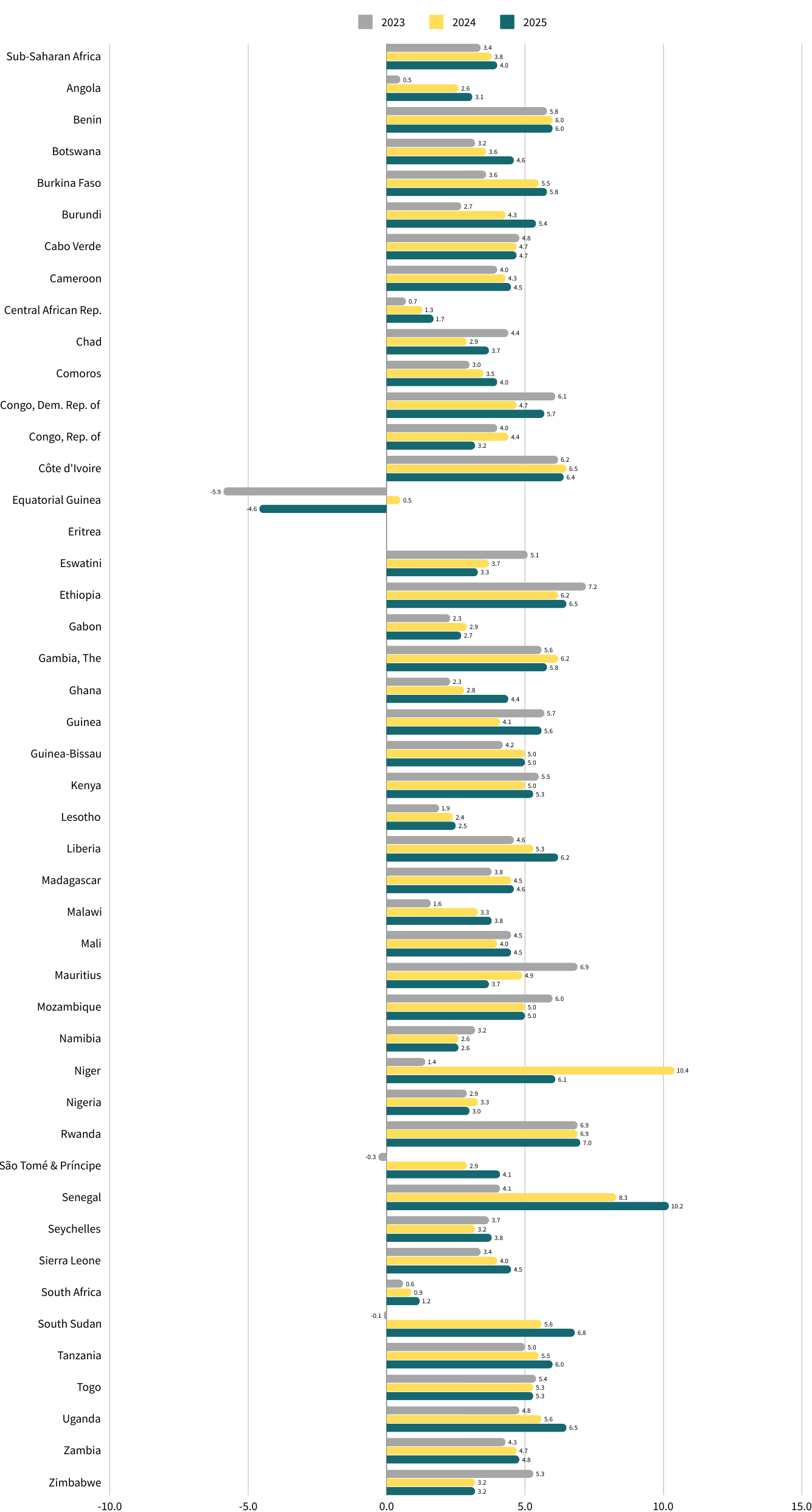
Source: IMF, World Economic Outlook Database, April 2024
- Growth in Central Africa is forecast to moderate from 4.3% in 2023 to 4.1% in 2024 before improving strongly to 4.7% in 2025. The upgraded forecast is due to expectations of stronger growth in Chad and the Democratic Republic of Congo due to favorable metal prices.
- East Africa, the continent’s fastest-growing region, will see real GDP growth rising from an estimated 1.5% in 2023 to 4.9% in 2024 and 5.7% in 2025. The downward revision of 0.2 percentage point for 2024 compared with the forecast in the January 2024 Africa’s Macroeconomic Performance and Outlook (MEO) is due to larger-than-expected contractions in Sudan and South Sudan following the ongoing conflict in the former.
- Growth is projected to pick up in West Africa, rising from an estimated 3.6% in 2023 to 4.2% in 2024 and consolidating at 4.4% the following year. This is an upgrade of 0.3 percentage point for 2024 over the January MEO 2024 projections, reflecting stronger growth in the region’s large economies— Côte d’Ivoire, Ghana, Nigeria, and Senegal.
- In North Africa, growth is projected to decline from an estimated 4.1% in 2023 to 3.6% in 2024 and 4.2% in 2025, with a downward revision of 0.3 percentage point for 2024 from the January 2024 MEO. Except for Libya and Mauritania, growth has been revised downward for all other countries in the region.
- Growth in Southern Africa is projected to pick up slightly from an estimated 1.6% in 2023 to 2.2% in 2024 and firm up to 2.7% in 2025. The growth rates for 2024 and 2025 show an upgrade of 0.1 percentage point over the January 2024 projections, mainly reflecting a 0.7 percentage point increase in South Africa’s projected growth. Due to South Africa’s larger weight in the region, the upgraded growth forecast offset the combined effect of downward revisions in Angola, Botswana, Lesotho, Zambia, and Zimbabwe
To combat inflation and exchange rate pressure, about two-thirds of African countries increased policy interest rates in 2022, while fiscal space remained constrained to support economic growth and sustainable development. Launched in 2019 to establish a unified market of 1.4 billion people and a GDP of around US$ 3.4 trillion, the AfCFTA is poised to become the world’s largest free trade area with 54 member states. The AfCFTA provides the economy of scale to invest in manufacturing and increased intra-Africa trade. By providing more opportunities for women and the youth, the AfCFTA helps reduce inequality and poverty and improves inclusion.
Established by the Economic and Social Council (ECOSOC) of the United Nations (UN) in 1958 as one of the UN’s five regional commissions, the United Nations Economic Commission for Africa’s (ECA’s) mandate is to promote the economic and social development of its member states, foster intraregional integration and promote international cooperation for Africa’s development. ECA comprises 54 Member States and plays a dual role as a regional arm of the UN and as a key component of the African institutional landscape.
The African Economic Outlook 2024 calls for an overhaul of the global financial architecture to transform African economies. This includes giving Africa a greater voice in multilateral development banks and international financial institutions, reflecting its growing share of global gross domestic product and rich natural resources. The report highlights the glaring inadequacies of the current global financial system in closing Africa’s financing gap for structural transformation, estimated at US$402.2 billion annually between now and 2030. To rectify these disparities, the report proposes a bold agenda for reforming the global financial architecture, including in the five following key areas:
Leveraging Private Sector Financing: The report advocates for greater private sector participation to complement public investments, particularly in areas with high social returns, such as climate action and human capital development.
Simplifying the Global Climate Finance Architecture: The report calls for streamlining the global climate finance architecture to enhance coordination and facilitate access for African countries, which are disproportionately affected by climate change.
Reforming Multilateral Development Banks (MDBs): The report also urges Multilateral Development Banks (MDBs) to revise their business models to provide long-term concessional financing at scale to developing countries, bolstering their capital positions, channeling a portion of IMF’s Special Drawing Rights (SDRs) to MDBs and ensuring a healthy replenishment of the concessional windows of the African Development Bank and the World Bank—the African Development Fund and the International Development Association.
Streamlining Debt Resolution Mechanisms: Recognizing the slow and cumbersome nature of existing debt resolution mechanisms, the report advocates for reforms to expedite debt workouts and ensure sustainable debt management, including innovative market-based solutions like “Brady bonds,” debt relief for climate purposes, and sovereign debt authority systems.
Enhancing Domestic Resource Mobilization: The report emphasizes the importance of strengthening domestic revenue mobilization through improved tax policies, enhancing efficiency in government revenue collection and utilization, combatting illicit financial flows and tax avoidance, and leveraging Africa’s abundant natural resources.