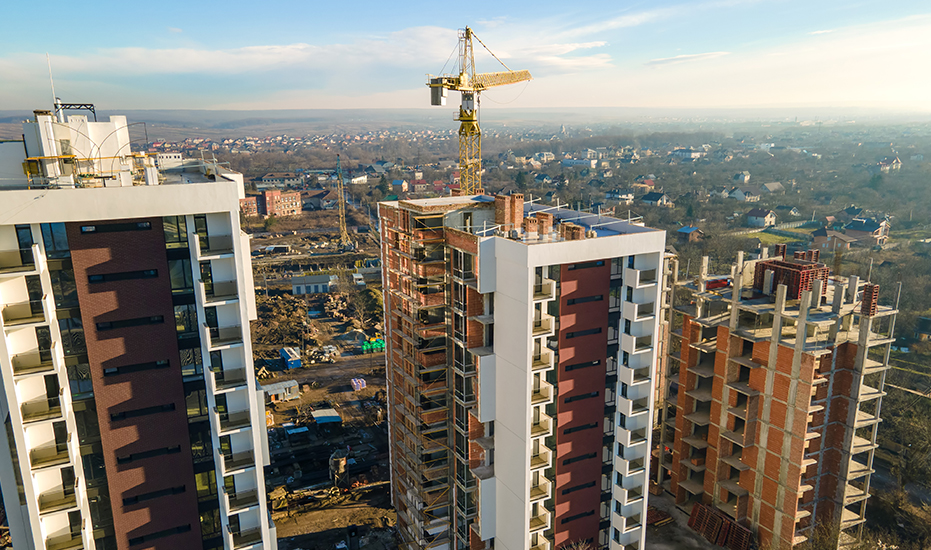
The African real estate market is growing and maturing, albeit with different trajectories and challenges in the various regions. The sector’s growth over the last decade has not been linear or smooth. The rise and completion of developments, a steady increase in transaction activity, and an increase in expansion into new real estate centers have been noted. Most importantly, stakeholders have to take a longer-term view of investment.
Real estate in Africa is also the leading driver of the continent’s post-pandemic recovery, with over $800 million in deals occurring annually. According to Statista data, real estate investments in Africa have seen steady growth over the past few years. This year, the African real estate market is expected to reach a value of US$15.98tn, with the residential real estate segment dominating with a projected market volume of US$13.39tn in 2024. Further, Statista data anticipates that the African real estate market will experience an annual growth rate of 5.92% from 2024 to 2028, resulting in a market volume of US$20.11tn by 2028.
Africa’s property market will be worth almost US$16 trillion in 2024 according to Statista, which anticipates an annual growth rate of nearly 6% over the next four years. The continent’s construction sector is also growing. Analysis by Mordor Intelligence projects the market to reach almost US$75 billion over the next five years.
Real estate is a profitable sector in Sub-Saharan Africa due to the region’s fast-rising population and high demand for accommodation. Already, some investors are making a fortune by pushing up property/rent prices in several cities across the continent, thus making real estate ideal for potential new investors. Increased investment has been noted in developing A-grade offices, large-scale retail malls, and high-end residential units. Another activity has been noted in projects in the maturity phase. This segment has been characterized by market corrections, the sale of assets developed during the first phase, and the exit of certain pioneering companies.
Land ownership in Africa is of two types; Free and Restricted (leased). In many African countries, foreigners are given land access on a lease. Property ownership is only for a specific time frame in a leasehold property market. The lease contract grants its holder temporary ownership and freedom to use the land for a duration. In most African countries, properties are leased for 99 years. In some other countries, the lease duration is usually shorter.
The past decade has seen three countries, Nigeria, Kenya, and Egypt, emerging as key markets for real estate investment on the continent. South Africa is one of the leading destinations for real estate investment in Africa, attracting significant foreign direct investment (FDI) in the sector. When it comes to the sectors driving real estate growth, the hospitality and retail sectors are leading, with increasing interest in mixed-use developments and commercial properties seen across the continent.
The Egyptian real estate market has generally emerged as a winner from the pandemic. According to the Ministry of Planning, the sector grew by 8% in 2021, with developers noting that the local real estate sector remains stable for the first time in 15 years. Overall, the market attracted approximately $10 billion in sales in 2021, with further foreign investments of $ 500 million underpinning the growing investor confidence in the market.
Egypt, like Morocco, offers international insurance for land titles. Foreigners are free to buy land, and the entire process is credible and transparent. The comprehensive land records in Egypt give the buyer peace of mind, whether it’s a foreign or domestic buyer. Like most other African countries, Egypt restricts the ownership of two prime real estates. These are South Sinai and Sharm El Sheikh. Land in these areas is only available on a 99-year lease. Regarding countries with friendly policies for foreign investment in African real estate, Egypt ranks among the best.
A report by Statista forecasts promising growth for Kenya’s Residential Real Estate market, with a projected value of US$0.62 trillion by 2024. The market is expected to maintain a steady annual growth rate of 3.81% from 2024 to 2028, reaching a market volume of US$0.72 trillion by the end of 2028. This indicates a robust trajectory for the country’s real estate sector.
South Africa has one of the most accessible real estate markets in Africa, where foreigners can easily buy and own properties. This includes agricultural lands, which in most other African countries is typically restricted to foreigners. However, it’s worth noting that an alternative to freehold is equally practiced in South Africa. Sectional title is no different from freehold except that it offers the owner of the property less freedom. In exchange for this inconvenience, owners of sectional titles have greater peace of mind regarding security. The Real Estate market in South Africa is expected to reach a value of US$1.23tn in 2024. Within this market, Residential Real Estate holds the dominant position with a projected market volume of US$0.86tn in the same year. It is anticipated that the market will experience an annual growth rate of 3.66% (CAGR 2024-2028), resulting in a market volume of US$1.42tn by 2028.
In Mauritius, foreigners needed a minimum of $500,000 to invest in real estate, which later changed to $350,000. The investment equally grants the investor a permanent residence for 20 years. Taking things a notch higher, the government of Mauritius proposed an attractive deal. Early investors are granted special privileges to invest in residential apartments around the smart cities.
Infrastructural activities in the construction and real estate sector increased in its contribution to Nigeria’s real Gross Domestic Product in Q1 2024. According to the latest data released by the Nigeria Bureau of Statistics recently, the sector contributed a total of N11.2tn in the quarter compared to the N9.1tn generated in the fourth quarter of 2023. The report stated that the real estate sector contributed 5.20 per cent to the GDP in the Q1 of 2024, while the construction sector contributed 4.0 per cent of the GDP in Q1 of 2024. According to the report, in nominal terms, real estate services in the first quarter of 2024 grew by 126.71 per cent, higher by 124.34 per cent points than the growth rate reported for the same period in 2023 and also higher compared to the preceding Quarter. The report stated, “On a quarter-on-quarter, the sector growth rate was 58.59 per cent. The contribution to nominal GDP in Q1 2024 stood at 8.80 per cent, relative to 4.46 per cent recorded in the first quarter of 2023 and 4.95 per cent in the fourth quarter of 2023.
Real GDP growth recorded in the sector for the first quarter of 2024 stood at 0.84 per cent, lower than the growth recorded in the first quarter of 2023 by 0.86 per cent points, and lower by 0.50 per cent points relative to Q4 2023. On a quarter-on-quarter, the sector grew by -27.88 per cent in the first quarter of 2024. It contributed 5.20 per cent to real GDP in Q1 2024, lower than the 5.31 per cent it recorded in the corresponding quarter of 2023. While the report noted that the Construction sector grew by -0.29 per cent in nominal terms (year-on-year) in the 2024 first quarter, a decrease of 38.00 per cent points compared to the rate of 37.71 per cent recorded in the same quarter of 2023.
According to recent projections from Statista, the market value of real estate in Ghana is anticipated to soar to an impressive US$458.50 billion in 2024, with residential real estate emerging as the dominant segment, accounting for a significant share of this growth. Among the various segments of the market, Residential Real Estate is expected to dominate with a projected market volume of US$389.10bn in the same year. Furthermore, the market is anticipated to maintain a steady growth rate in the following years, with an annual growth rate (CAGR 2024-2028) of 5.48%. This growth trajectory is predicted to result in a market volume of US$567.60bn by the year 2028.
Over the past decade, investment in the sector has seen sophisticated deal structuring in affordable housing, hospitality, logistics, office spaces, and mixed-use spaces across countries and regions. With increasing urbanization and demand for integrated living and working spaces, mixed-use developments have become popular in the country’s major cities. These developments typically combine residential, commercial, and retail components to create vibrant urban hubs. There has been an increase in gated communities that offer security, amenities, and a sense of community. These developments have gained popularity among middle—and high-income earners in Africa. They feature residential properties ranging from apartments to villas accompanied by recreational facilities and green spaces.
While not insignificant, the forecasted growth in these sectors fall far short of what is needed for us to solve Africa’s growing housing shortage. In fact, some research suggests that the continent’s housing backlog amounts to over 51 million units (with 17 African countries having a shortage of over a million units). While the price tag of closing this gap is steep – roughly US$2 trillion over a decade –the ramifications of doing so for GDP growth and job creation would be far-reaching, and include:
- Unlocking more than US $5 trillion in output across the broader economy
- Creating 288 million full-time-equivalent jobs over a decade (an average of 26 million annually)
- Boosting the industrialization of Africa’s economies, most of which have been overly oriented towards the extraction of resources