


Africa’s Progress Towards Middle-Income Status
The number of middle-class Africans has tripled over the last 30 years to 313 million people, or more than 34% of the continent’s population, according to a new report from the African Development Bank (AfDB). The reasons for the increase in size and purchasing power of the African middle class include strong economic growth and a move towards a stable, salaried job culture and away from traditional agricultural activities.
The report ‘The Middle of the Pyramid: Dynamics of the Middle Class in Africa,’ however, warns that despite this phenomenon, income inequality in Africa remains very high and that the overall middle-class figure includes large numbers of a ‘floating class’ whose hold on status is insecure. Moreover, according to a 2019 World Bank report, poverty rates in Africa decreased from 54% in 1990 to just over 41% in 2015 (affecting around 400 million people). If these trends continue, Africa’s poverty rates could reach as low as 23%.
Overall, economic growth determines the rise of the middle class, but social and economic factors drive economic growth. Africa’s middle class is strongest in countries with a robust and growing private sector, as many middle-class individuals tend to be local entrepreneurs. In some African countries, a new middle class has emerged due to opportunities the private sector offers. Other determining factors include establishing stable, secure, well-paid jobs and higher levels of tertiary education. North Africa has a stronghold on middle-class individuals, with Tunisia coming in first place with a concentration of almost 90%. Morocco is a close second with 85%, and Egypt is in third place with 80%. Other African countries with a high concentration of middle-class individuals include Botswana, Ghana, Namibia, Mozambique, Malawi, Rwanda, Burundi, Kenya, and South Africa.
Increasing Number of Middle-Income States
Before the pandemic, data suggested that the continent was expected to grow GDP by 3-5% annually. More than a third of the countries in Africa are expected to have GDP growth higher than 6%, and 40% are expected to have GDP growth between 4 and 6%. By 2025, the continent is projected to be a “middle-income” continent, with an average GDP per capita of over $1000.
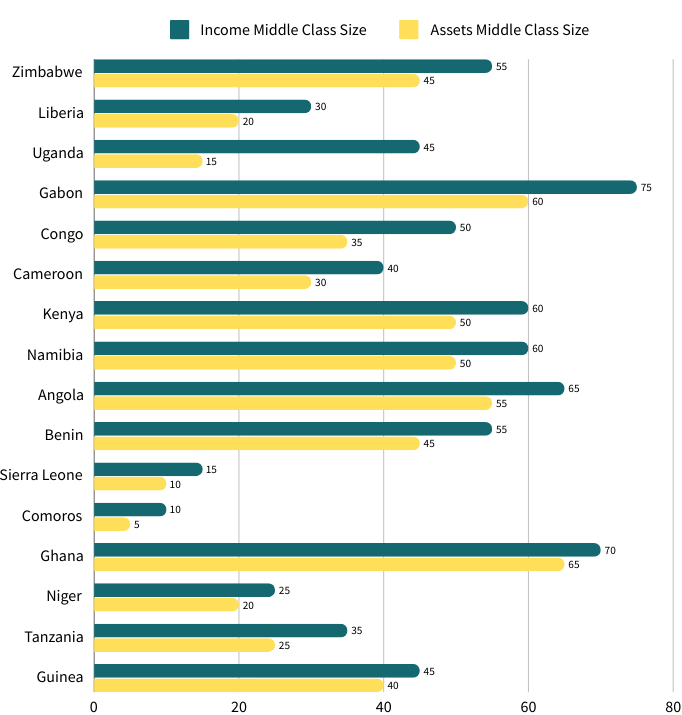
Graph A Showing the Middle-Class Sizes (%) for Countries with Larger African Income Middle Class.
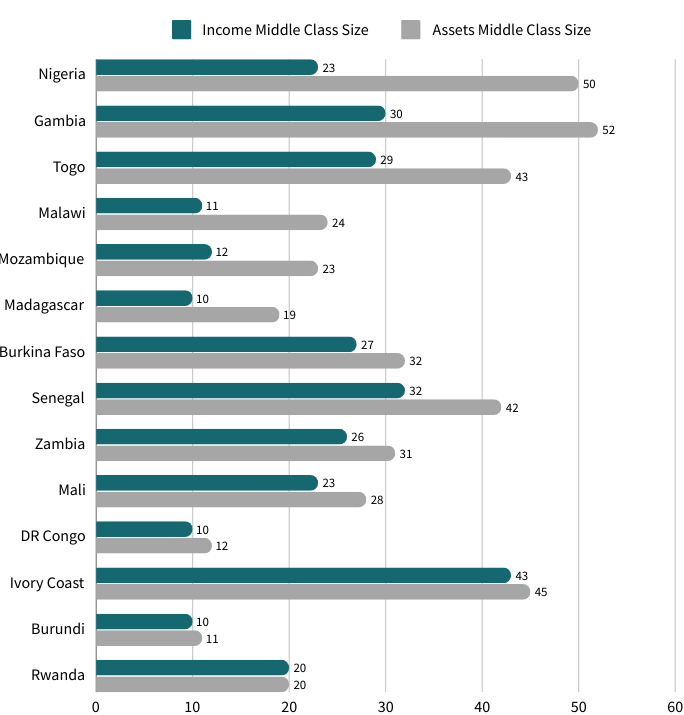
Graph B Showing the Middle-Class Sizes (%) for Countries with Larger African Assets Middle Class.
- Growth in Central Africa is forecast to moderate from 4.3% in 2023 to 4.1% in 2024 before improving strongly to 4.7% in 2025. The upgraded forecast is due to expectations of stronger growth in Chad and the Democratic Republic of Congo due to favorable metal prices.
- East Africa, the continent’s fastest-growing region, will see real GDP growth rising from an estimated 1.5% in 2023 to 4.9% in 2024 and 5.7% in 2025. The downward revision of 0.2 percentage point for 2024 compared with the forecast in the January 2024 Africa’s Macroeconomic Performance and Outlook (MEO) is due to larger-than-expected contractions in Sudan and South Sudan following the ongoing conflict in the former.
- Growth is projected to pick up in West Africa, rising from an estimated 3.6% in 2023 to 4.2% in 2024 and consolidating at 4.4% the following year. This is an upgrade of 0.3 percentage point for 2024 over the January MEO 2024 projections, reflecting stronger growth in the region’s large economies— Côte d’Ivoire, Ghana, Nigeria, and Senegal.
- In North Africa, growth is projected to decline from an estimated 4.1% in 2023 to 3.6% in 2024 and 4.2% in 2025, with a downward revision of 0.3 percentage point for 2024 from the January 2024 MEO. Except for Libya and Mauritania, growth has been revised downward for all other countries in the region.
- Growth in Southern Africa is projected to pick up slightly from an estimated 1.6% in 2023 to 2.2% in 2024 and firm up to 2.7% in 2025. The growth rates for 2024 and 2025 show an upgrade of 0.1 percentage point over the January 2024 projections, mainly reflecting a 0.7 percentage point increase in South Africa’s projected growth. Due to South Africa’s larger weight in the region, the upgraded growth forecast offset the combined effect of downward revisions in Angola, Botswana, Lesotho, Zambia, and Zimbabwe
To combat inflation and exchange rate pressure, about two-thirds of African countries increased policy interest rates in 2022, while fiscal space remained constrained to support economic growth and sustainable development. Launched in 2019 to establish a unified market of 1.4 billion people and a GDP of around US$ 3.4 trillion, the AfCFTA is poised to become the world’s largest free trade area with 54 member states. The AfCFTA provides the economy of scale to invest in manufacturing and increased intra-Africa trade. By providing more opportunities for women and the youth, the AfCFTA helps reduce inequality and poverty and improves inclusion.
Established by the Economic and Social Council (ECOSOC) of the United Nations (UN) in 1958 as one of the UN’s five regional commissions, the United Nations Economic Commission for Africa’s (ECA’s) mandate is to promote the economic and social development of its member states, foster intraregional integration and promote international cooperation for Africa’s development. ECA comprises 54 Member States and plays a dual role as a regional arm of the UN and as a key component of the African institutional landscape.
The African Economic Outlook 2024 calls for an overhaul of the global financial architecture to transform African economies. This includes giving Africa a greater voice in multilateral development banks and international financial institutions, reflecting its growing share of global gross domestic product and rich natural resources. The report highlights the glaring inadequacies of the current global financial system in closing Africa’s financing gap for structural transformation, estimated at US$402.2 billion annually between now and 2030. To rectify these disparities, the report proposes a bold agenda for reforming the global financial architecture, including in the five following key areas:
Leveraging Private Sector Financing: The report advocates for greater private sector participation to complement public investments, particularly in areas with high social returns, such as climate action and human capital development.
Simplifying the Global Climate Finance Architecture: The report calls for streamlining the global climate finance architecture to enhance coordination and facilitate access for African countries, which are disproportionately affected by climate change.
Reforming Multilateral Development Banks (MDBs): The report also urges Multilateral Development Banks (MDBs) to revise their business models to provide long-term concessional financing at scale to developing countries, bolstering their capital positions, channeling a portion of IMF’s Special Drawing Rights (SDRs) to MDBs and ensuring a healthy replenishment of the concessional windows of the African Development Bank and the World Bank—the African Development Fund and the International Development Association.
Streamlining Debt Resolution Mechanisms: Recognizing the slow and cumbersome nature of existing debt resolution mechanisms, the report advocates for reforms to expedite debt workouts and ensure sustainable debt management, including innovative market-based solutions like “Brady bonds,” debt relief for climate purposes, and sovereign debt authority systems.
Enhancing Domestic Resource Mobilization: The report emphasizes the importance of strengthening domestic revenue mobilization through improved tax policies, enhancing efficiency in government revenue collection and utilization, combatting illicit financial flows and tax avoidance, and leveraging Africa’s abundant natural resources.