

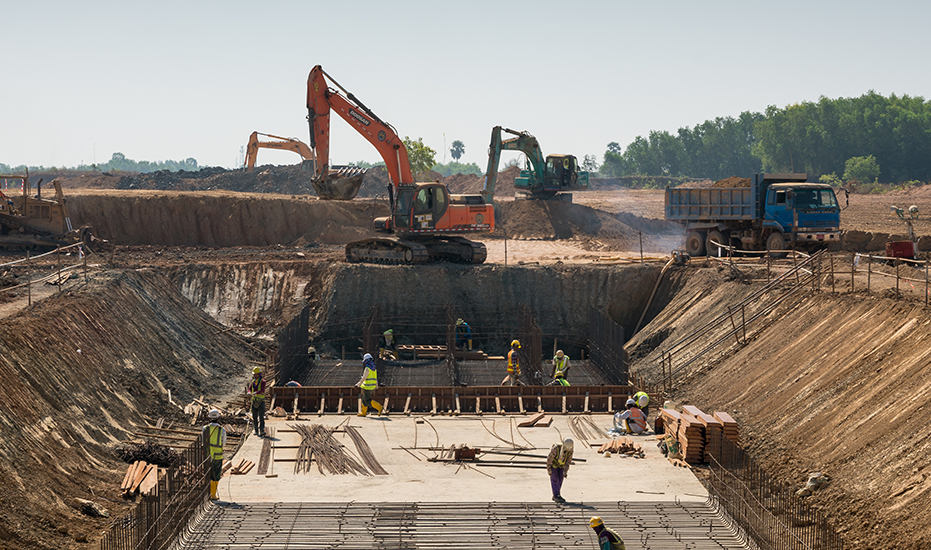
African countries have heavily invested in infrastructure and superstructure construction projects. The construction industry is one of the continent’s rapidly growing sectors and greatly contributes to employment. In 2019, there was approximately $500 billion investment in the 452 largest projects in Africa. According to Mordor Intelligence, the Africa Construction Market size is estimated at $58.42 billion in 2024 and is expected to reach $74.81 billion by 2029, growing at a CAGR of 5.07% during the forecast period (2024-2029). This is only set to increase as the market is expected to register a Compound Annual Growth Rate (CAGR) of 7.4% between 2021 and 2026.
In 2023 there was a slight decline in the infrastructure investment funds allocated to Africa, save North Africa, according to a report by the World Bank. This fall is specific to private investors’ handling of private infrastructure investments. The report revealed that “In 2023, SSA saw investments in 66 projects totaling $3.5 billion. This marked a 24 percent decrease from the investment levels of the previous year and a 46 percent decrease from the past five-year average. The largest contributor to the region’s PPI was South Africa, responsible for 30 percent of the regional PPI, followed by Senegal and Tanzania.”
Regionally, Africa will become a major player in global construction over the next four years. There will be a steady acceleration in construction activity in Nigeria’s efforts (4.6% CAGR) to revitalize the economy by focusing on developing the country’s infrastructure. However, Ethiopia (12.7% CAGR) will be Africa’s best performer. Its construction industry will continue to grow (albeit from a lower base than some of the continent’s other leading countries) in line with the country’s economic expansion.
This rapid pace of growth is driven by both public sector spending on infrastructure development projects and private investment in residential housing units as well as commercial buildings such as shopping malls with retail outlets. Energy, power, and transport projects have consistently been key contributors to the sectoral mix of projects underway. The real estate sector – predominantly commercial – has emerged as a critical sector in recent years. With population increase and urbanization in Africa, the strong growth of the construction sector is inevitable. However, many crucial challenges remain, like financing, available electrical grids, transportation, procurement, and skilled employees.
Demand for green cement in Africa will provide an increasingly lucrative market over the next few years due to growing trends in sustainability and energy efficiency for both buildings and infrastructure. The coming years will witness increased demand from local African marketplaces for more sustainable products in the local built environment.
Currently, Kenya’s construction industry is going through a boom. The government has invested heavily in the construction sector of Kenya to improve the infrastructure, such as road networks, and at the same time, provide new residencies for the locals (who are being supported by the banks to get a loan to buy apartments/cars). According to the Kenya National Bureau of Statistics, the real estate and construction sectors have continued to be key drivers of economic growth in Kenya for the last five years. The Kenyan construction industry contributes 7% of the gross domestic product (GDP), which makes it clear that Kenya has a well-developed construction industry. With the increased population, opportunities exist in constructing residential, commercial, and industrial buildings, including prefabricated low-cost housing.
Infrastructure development is a central pillar of Kenya’s Vision 2030, and in 2015 the $3 billion construction sector contributed 4.8% to the Kenyan economy. Kenya Vision 2030 overall goal for the construction sector is to increase its contribution to GDP by at least 10% per annum and propel Kenya toward becoming Africa’s industrial hub. The Economic Survey 2016 published by the Kenyan National Bureau of Statistics (KNBS) reported that approximately 148,000 people are formally employed in the domestic building and construction industry. Players in the sector range from indigenous micro-enterprises to foreign multinational civil engineering and construction giants. Although building and construction contractors must be registered with the National Construction Authority (NCA), many unregistered contractors operate in the informal sector.
Nigeria is often highlighted as one of the most attractive markets in Africa for construction works. Of the nearly $120bn committed to infrastructure spending across 92 projects in West Africa, 61% is earmarked for plans in Nigeria. The country currently has over 68 major building projects with a total capital expenditure of over $73 billion, second only to South Africa on the entire African continent. Given the size of the Nigerian economy and the traditional spending of other African states, these figures mask a historical underspend in gross fixed capital formation (GFCF), a category that includes infrastructure projects and land improvements. An average GFCF of 30% of GDP is optimal for creating a growth-conducive environment. In recent years Nigeria has spent just 11.9% of its GDP compared to a sub-Saharan Africa average of 21.5%. The continental leader Ethiopia spent an average of 32.8% of its GDP on infrastructure over the last decade.
The South African construction market was valued at $29 billion in 2021 and is expected to achieve an AAGR of more than 2% from 2023-2026. During the forecast period, the growth will be supported by investment in transport, electricity, water, sewage, and housing infrastructure projects. The key sectors in the South African construction market are commercial, industrial, infrastructure, energy & utilities, institutional, and residential constructions. The infrastructure construction was the largest sector in South Africa’s construction industry in 2021. The leading contractors in the South African construction market are Wilson Bayly Holmes-Ovcon Ltd, Stefanutti Stocks Holdings Ltd, Basil Read Pty Ltd, Roshcon, and Balwin Properties Ltd, among others. Wilson Bayly Holmes-Ovcon Ltd has the highest project value in the South African construction market. The leading consultants in the South African construction market are iX Engineers Pty Ltd, Incico SpA, Amandla Engineering Pty Ltd, SRK Consulting (Global) Ltd, and GIBB (Pty) Ltd. iX Engineers Pty Ltd has the highest project value in South African construction market.
As a region, East Africa had the largest number of recorded projects, with 139 projects between 2018 and 2019. North Africa accounted for the largest share of projects in terms of value at 31.5% (US$148.3bn). The projects included were spread over 43 of Africa’s 54 countries. Egypt was the single country with the most projects, with 46 projects (9.5% of projects on the continent) and the most projects by value at US$79.2bn (17% of the continent’s value), edging out South Africa and Nigeria, respectively. The Transport construction sector had 186 projects (22.7% of the total project value), followed by power and energy projects (with a share of 24.4% of the total project value).
The construction industry employs many people, and each year, billions of dollars are invested in it through government funding, consortiums, and private investors. The African construction industry is the target destination for most large economies because of accruing benefits, such as the availability of natural resources, huge investment opportunities in energy and infrastructure, cheap labor, and a fast-growing consumer market. Africa also has a beneficial business environment that includes favorable economic development policies, rising commodity prices, continued progress in the fight against corruption, and adoption of democratic governments.
Industry Leaders
Industry leaders

South Africa

Uganda

Kenya
Publications/Resources
Building and Infrastructure Associations in Africa