

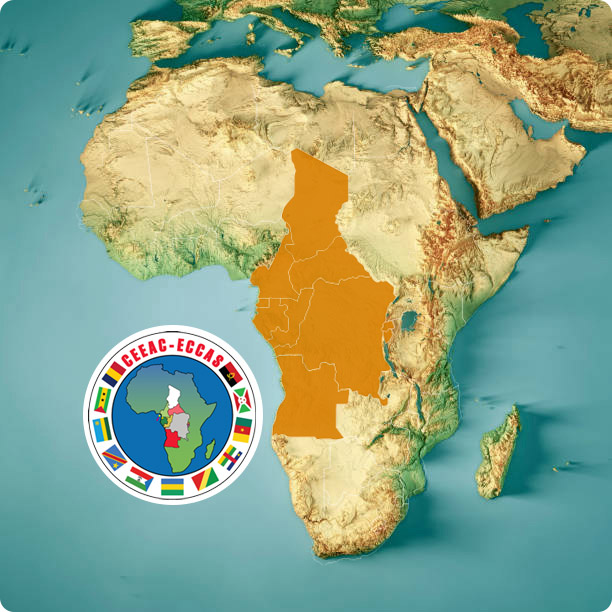
 ECCAS is a regional body comprised of 10 member States, namely Angola, Burundi, Cameroon, Central African Republic, Chad, Congo, DRC, Equatorial Guinea, Gabon, and Sao Tome and Principe. It was formed by signing the Treaty in October 1983 and came into effect in December 1984. Its primary objective is to promote member States’ economic and social development and improve people’s living conditions.
Article 4 of the Treaty outlined the Community’s objectives as follows:
- Achieve collective autonomy
- Raise the standard of living of its population
- Maintain economic stability through harmonious cooperation
From 1992 to 1998, activities were suspended due to crises within its member States making its four priority fields even more important to follow. These are to: develop capacities to maintain peace, security, and stability as essential prerequisites for economic and social development; develop physical, economic, and monetary integration; develop a culture of human integration; and establish an autonomous financing mechanism for ECCAS.
ECCAS’s supreme organ is the Conference of Heads of State or Government. It is also supported by the Council of Ministers, General Secretariat, Court of Justice, Technical specialized committees, and Consultative Commission.
Central Africa has significant potential for export to the rest of Africa, estimated at US$4.3 billion. Interestingly, while countries across Africa tend to engage in less intracontinental trade compared to trade with the rest of the world, this external orientation of trade is particularly pronounced within Central Africa when compared to other subregions. Among the products demonstrating the highest export potential in Central Africa are metals, wood, vegetable oil, motor vehicles and parts, food products, machinery and electricity, ferrous metal, rice, vegetal residues, and cocoa beans. Collectively, these products contribute to approximately 20 percent of the region’s total export potential.
In contrast to other subregions, Central Africa’s greatest export potential does not lie within its own region but rather in North Africa, estimated at US$458 million. This figure represents about 10.7 percent of Central Africa’s total intra-African export potential. Key products with significant export potential to North Africa include metals, wood, vegetal residues, and animal feed. Southern Africa emerges as the second-highest potential market for Central African exports, estimated at US$236 million. Following closely, Central Africa itself presents the third-greatest potential, estimated at US$165 million, followed by East Africa, with an estimated US$78 million. Notably, West Africa has the lowest potential as an export market for Central Africa, estimated at US$51 million. These insights underscore the varied export opportunities within and across African regions, highlighting the potential for deeper regional economic integration and trade cooperation.