

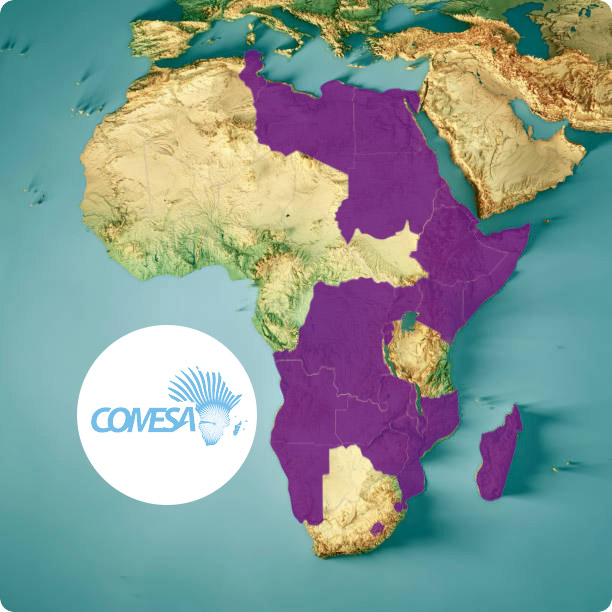
 The Common Market for Eastern and Southern Africa (COMESA) comprises 21 African Member States that came together to promote regional integration through trade and the development of natural and human resources for the mutual benefit of all people in the region. COMESA countries include Burundi, Comoros, Dem Rep. of Congo, Djibouti, Egypt, Eritrea, Ethiopia, Eswatini, Kenya, Libya, Madagascar, Malawi, Mauritius, Rwanda, Seychelles, Somalia, Sudan, Tunisia, Uganda, Zambia, and Zimbabwe. COMESA was formed in December 1994, replacing a Preferential Trade Area which had existed since 1981. In 2008, COMESA agreed to an expanded free-trade zone, including members of two other African trade blocs, the East African Community (EAC) and the Southern Africa Development Community (SADC). COMESA is also considering a common visa scheme to boost tourism.
With its 21 Member States, a population of over 640 million, a Gross Domestic Product of $1.0 trillion, and a global export/import trade in goods worth $383 billion, COMESA forms a major marketplace for both internal and external trading. Geographically, COMESA is almost two-thirds of the African Continent, with an area of 12 Million (sq km).
A report presented by COMESA Secretariat on trade developments in the region indicated that the value of intra-COMESA total exports increased by 10% from US$12.8bn in 2021 to US$14.1bn in 2022. COMESA’s global trade and within the region recorded a significant increase, with the total exports to the world increasing by 15% from US$179bn in 2021 to US$205bn in 2022. The largest exporting countries in the COMESA region were Libya, Egypt, Tunisia, and Sudan. These had a combined market of 98% in exported fuels in 2022. U.S. goods exports to COMESA in 2022 were $10.2 billion, up 14.1% ($1.3 billion) from 2021 and up 7% from 2012. U.S. goods imports from COMESA totaled $9.4 billion in 2022, up 2.2 percent ($201 million) from 2021 and up 24% from 2012. The U.S. trade balance with COMESA shifted from a goods trade deficit of $221 million in 2021 to a goods trade surplus of $842 million in 2022.
The COMESA Free Trade Area (FTA) was achieved on 31st October 2000 when nine member states, namely Djibouti, Kenya, Madagascar, Malawi, Mauritius, Sudan, Zambia, and Zimbabwe, eliminated their tariffs on COMESA-originating products, under the tariff reduction schedule adopted in 1992. This followed a trade liberalization program that commenced in 1984 on reducing and eliminating tariff and non-tariff barriers to intra- regional trade. Burundi and Rwanda joined the FTA on 1st January 2004. These eleven FTA members have not only eliminated customs tariffs but are working on the eventual elimination of quantitative restrictions and other non-tariff barriers.