

The African Economic Community (AEC) was founded in 1991 by the African Union to establish grounds for developing a single African continental economy, incorporating a free trade area, a single market and customs union, one central bank, and a common currency. The pillars of the AEC are the “regional economic communities” or (RECs). The African Union (AU) recognizes 8 officially recognized regional economic communities (RECs). These are regarded as building blocks of the AfCFTA. Overlapping membership complicates the implementation processes.

Additionally, African nations have developed a further six regionally focused economic structures as well.
- Arab Maghreb Union (AMU) – 5.44%
- Common Market for Eastern and Southern Africa (COMESA) – 20.32%
- Community of Sahel–Saharan States (CEN–SAD) – 16.59%
- East African Community (EAC) – 4.76%
- Economic Community of Central African States (ECCAS) – 5.9%
- Economic Community of West African States (ECOWAS) – 10.18%
- Intergovernmental Authority on Development (IGAD) – 4.7%
- Southern African Development Community (SADC) – 32.12%
The African Continental Free Trade Area (AfCFTA) has opened a new chapter for the continent and rekindled hopes for recovery through trade in a post-COVID-19 world. As nations continue to battle a pandemic that does not respect national borders, the $3.4 trillion borderless market created by the AfCFTA presents an opportunity to reduce COVID-19-induced growth contraction, poverty, and inequality trends and spur sustainable and inclusive growth on the continent.
The internal EAC market has about 146 million consumers, while the Common Market for Eastern and Southern Africa (COMESA) comprises 20 member states with a population of over 460 million. Rwanda, Kenya, Uganda, and Burundi are all members of COMESA. Intra-African trade is currently low at 14.4% of total African exports. UNCTAD estimates that the AfCFTA could boost intra-African trade by about 33% and cut the continent’s trade deficit by 51%.
Intra-African trade increased by 7.2% in 2023, reaching $192 billion, according to a report released by the African Export-Import Bank (Afreximbank) on Wednesday, June 12, 2024. The report, titled “African Trade Report 2024: Climate Implications of the AfCFTA Implementation,” highlighted that intra-regional trade accounted for 15% of Africa’s total trade last year, up from 13.6% in 2022. However, this increase reveals major disparities between the continent’s sub-regions. With 41.4%, Southern Africa remains the main driver of trade between African countries, compared with 25.7% for West Africa, 14.1% for East Africa, 12.4% for North Africa and 6.6% for Central Africa.
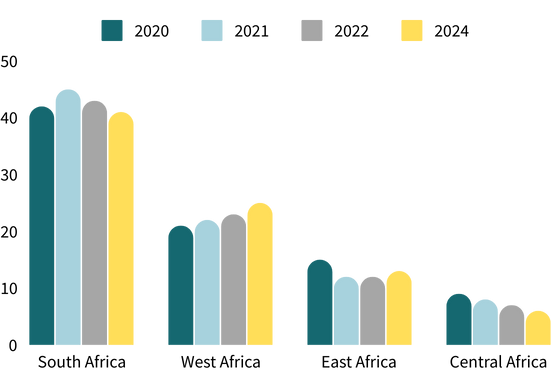
However, the report noted a 6.3% decrease in the overall value of Africa’s intra-regional and extra-regional trade in 2023, totaling approximately $1.3 trillion. This decline was attributed to several factors, including global demand for raw materials slowing down due to geopolitical tensions from the prolonged war in Ukraine and the Middle East conflict, persistent high interest rates, and economic slowdowns in China and other developed nations.
Oil, which makes up over 36% of Africa’s total exports, saw price volatility negatively affecting the continent’s trade performance. The average price of crude oil fell to $82.62 per barrel in 2023, down from around $99.82 per barrel in 2022. Major oil exporters like Nigeria, Angola, Equatorial Guinea, Gabon, and Libya were significantly impacted. For instance, Nigeria experienced a 19.08% drop in its total trade with the rest of the world in 2023.
The report also highlighted shifting trade partnerships for Africa as emerging Asian economies become significant sources of demand and growth. The European Union’s share in Africa’s exports declined from an average of 47.8% in the 1990s to 26.8% during the decade from 2014 to 2023. Conversely, Asia’s share rose from 4.5% in the 1990s to 26% in the last decade.

Source: IMF, Direction of Trade Statistics, Afreximbank
The signing of the African Continental Free Trade Agreement (AfCFTA) will increase intra-regional trade from 18% to 60%. African countries have begun trading in the African Continental Free Trade Area (AfCFTA, which will be among the largest free trade areas in the world when fully operational. AfCFTA may present significant opportunities for increased foreign direct investment (FDI) in Africa.
As a result of the AfCFTA, Africa’s GDP is expected to increase by 0.91 percent, or US$34.76 billion. In terms of trade, while implementing the AfCFTA, which is expected to increase total exports and imports of African countries, there is a trade diversion from other countries on the continent. Intra-African trade jumps 33.04 percent, while imports and exports with the rest of the world are expected to decline slightly by 0.04 percent and 0.03 percent, respectively. Production on the continent has also been shown to increase under the AfCFTA by 1.19 percent. Since the model shows a reduction in total consumption, it can be concluded that the increase in trade drives the increase in production.
By reducing tariff and non-tariff barriers to trade, investors in an AfCFTA member state may have access to an expanded market for goods and services across Africa. AfCFTA may also support harmonizing existing and new regulatory requirements across borders that lower regional business costs. Given that Africa has lagged behind other regions as a destination for FDI, AfCFTA may provide investors with new investment opportunities that span multiple economic sectors.
The African Continental Free Trade Area (AfCFTA) provides a significant opportunity to promote international trade, economic growth, and increased market opportunities in Africa. AfCFTA signatories span the continent beyond the eight Regional Economic Communities recognized by the African Union. Negotiations surrounding AfCFTA were structured in phases. Phase I negotiations covered three protocols enacted in May 2020: Protocol on Trade in Goods, Protocol on Trade in Services, and Protocol on Rules and Procedures on the Settlement of Disputes. Issues related to competition policy, intellectual property rights, and investment are scheduled for Phase II negotiations.